
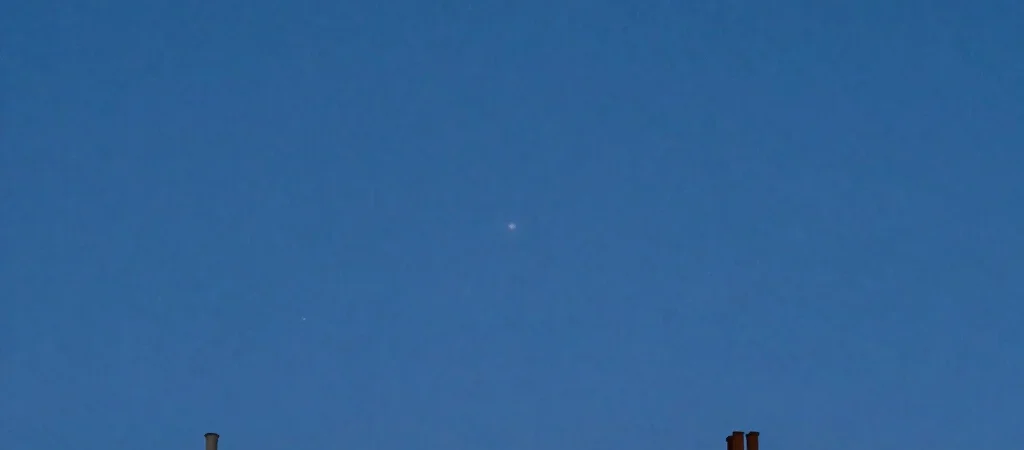
A bright point appears after sunset and seems almost too steady to be a star. It may be a planet, but brightness alone is not enough to identify it. Notice how it behaves, where it sits among familiar stars, and how its position changes over several evenings.
Watch how it shines
Stars often appear to twinkle because their light passes through moving layers of Earth’s atmosphere. Planets usually look steadier to the naked eye, but they can twinkle too, especially when they are low above the horizon. Treat this as a useful clue, not a rule that settles the question.
Compare it with the stars
The familiar patterns of stars keep their shapes over a night, while planets slowly shift their positions against that background over days and weeks. A single glance may not reveal the change, so make a quick sketch or return to the same place on another evening. A sky chart set for your location in France can help you check whether the bright object is a planet.
Check before naming it
Cloud, haze, buildings, and the time of year all affect what is visible, so avoid relying on a generic picture of the sky. Use a current planetarium app or an observing chart, and compare its time and location settings with your own. If the identification is uncertain, keep it uncertain; careful observing begins with separating what you saw from what you infer.